
Best Gravel for a Driveway in the Lower Mainland

The best gravel for a driveway isn't one product. It's a combination: a coarse, crushed base that carries the weight and drains, topped with a crushed surface gravel that has enough fine material to bind together and shed water.

That's why two driveways covered in "the same gravel" can behave so differently. One stays firm for years. The other turns into potholes and ruts by the end of the first wet season. In the Lower Mainland, where fall and winter bring long stretches of rain, the difference usually comes down to what's under the surface and how the driveway handles water.
This guide explains the driveway gravel types you'll hear about from suppliers and contractors in Metro Vancouver and the Fraser Valley, how a gravel driveway is built in layers, and what to avoid. If you're planning a new driveway or fixing an old one, see our gravel driveway installation and repair service.
Why there's no single "best gravel" for a driveway
A driveway has two jobs, and each one needs a different kind of material.
The base has to carry weight and let water drain out. The surface has to stay tight and stable under tires, and shed water instead of soaking it up.
The Gravel Roads Maintenance and Design Manual, written by the South Dakota Local Transportation Assistance Program for the U.S. Federal Highway Administration, makes the same distinction. It explains that base gravel usually has larger stone and very little fine material, which gives it strength and drainage. But that same material "will remain loose and unstable" when it's used as the driving surface.
According to the manual, good surface gravel is a blend of three things:
Stone, which gives strength to support loads, especially in wet weather.
Sand-sized particles, which fill the gaps between the stones.
Fines with a binding quality, which hold everything together so the surface forms a crust and sheds water.
Without a good blend of all three, the manual says, the gravel will perform poorly, no matter how well it's maintained.

Types of gravel for a driveway you'll hear about in the Lower Mainland
Supplier names vary from yard to yard, so always ask what's in the product, not just what it's called. These are the names most property owners run into:
Road base: a crushed mix of larger stone down to fines, used as the structural layer under the surface. It compacts well and is the backbone of a driveway that lasts.
3/4 minus gravel: crushed rock with a top size of about 3/4 inch, mixed with smaller pieces and fines. The "minus" means it includes everything smaller than the top size. It's a common choice for the top layer of a driveway because the stone, sand and fines lock together when compacted.
Crusher dust (screenings): the fine material left over from crushing rock. It packs tight and is useful for filling and levelling, but on its own it has little stone to carry weight and can turn soft or wash away when it's wet.
Drain rock and clear crushed rock: stone screened to one size with the fines removed. It's excellent where you want water to move, such as drainage work, but it doesn't bind into a firm driving surface.
Pea gravel and river rock: small, rounded stones. They look clean, but they roll under tires and don't lock together.
Crushed vs. rounded stone
Shape matters as much as size. The FHWA manual notes that broken, crushed stones "embed into the surface of a gravel road much better than rounded, natural-shaped stone" and resist movement under loads. That's the main reason crushed products like 3/4 minus and road base outperform rounded gravel on a driveway.
If you're comparing options for your own property, our page on gravel driveway installation and repair explains how we approach new builds and failing driveways.
How a gravel driveway is built in layers
A gravel driveway that lasts is built from the ground up, not just topped up. The work usually follows this order:
Prepare the subgrade. Soft soil, organic material and roots are removed so the driveway sits on firm ground. Skipping it can leave soft spots that show up later as ruts and potholes.
Place and compact the base. A crushed base layer, such as road base, is spread and compacted in lifts so it can carry vehicles without sinking.
Add the surface gravel. A crushed surface gravel with fines, such as 3/4 minus, goes on top and is compacted into a tight layer.
Shape the crown. The surface is graded so it's higher in the middle or tilted to one side, so water runs off instead of sitting on top.
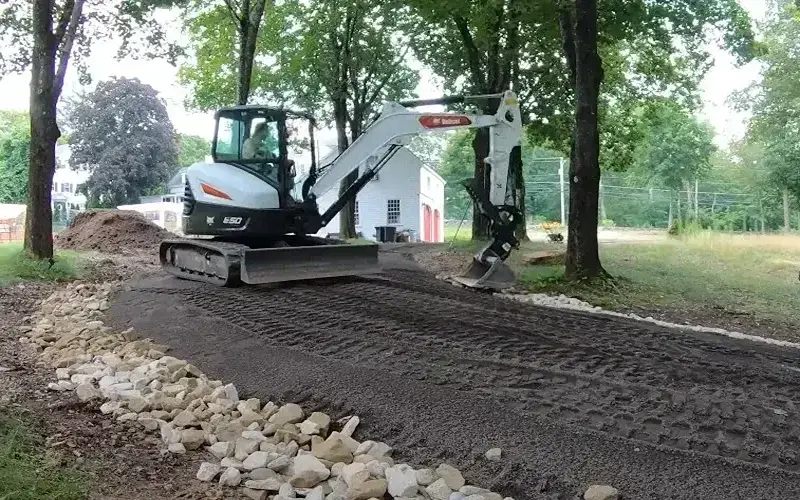
How deep each layer should be depends on the soil, the slope and what will drive on it. A driveway for a car is a different project from one that carries a loaded gravel truck, a tractor or an RV. That's why it's worth having someone look at the site before ordering material. If the driveway will cut through trees or brush, our post on land clearing cost in BC covers that first step.
For larger areas such as farm lanes, equipment yards or parking areas, see our gravel roads and parking pads page.
Why water decides how long a driveway lasts here
Water is one of the biggest reasons gravel driveways break down in the Lower Mainland. When water sits on the surface or soaks into the base, the gravel softens, tires push it aside, and potholes and ruts form.
Shape is the first line of defence. The FHWA manual recommends a crown of at least 1/2 inch per foot, or about 4%, on gravel roads so water runs off the driving surface. A driveway with no crown, or one that's lower than the ground around it, will hold water no matter how good the gravel is.
The base matters too. A clean, crushed base lets water drain down and away instead of turning the bottom of the driveway into mud. On sites with poor drainage, the grading around the driveway is often part of the fix. We look at drainage as part of site preparation and grading and driveway work when the project calls for it.
Gravel to avoid on a driveway
Some materials are cheap or easy to find but cause problems as a driving surface:
Pea gravel and river rock on their own. Rounded stones roll and spread, leave ruts, and get kicked into lawns and beds.
Sandy fill or pit run without processing. The manual explains that material made as fill is often high in sand so it drains quickly. That's good under a building, but it stays loose on a driving surface.
Crusher dust as the only layer. It packs well when dry, but without stone it can turn soft and wash out in heavy rain.
Recycled asphalt on its own. The FHWA manual says recycled asphalt can act like a weak pavement and develop potholes. It recommends placing it at least three inches deep on a strong subgrade, and notes that mixing it 50/50 with new gravel generally works better.
Fix the gravel or fix the base?
Adding a load of new gravel is the most common fix for a worn driveway, and often the least effective. If the problem is underneath, fresh gravel on top disappears into the same potholes within a season.
A few signs point to a deeper issue:
Potholes that come back in the same spots after every fill.
Ruts and soft areas that get worse in wet weather.
Water that pools on the driveway or runs down the middle of it.
Gravel that sinks into mud instead of staying on top.
In those cases, the driveway usually needs regrading to restore its shape, base correction in soft spots, or a rebuild of the failed section. A site visit is the fastest way to tell which one your property needs.

Frequently Asked Questions
What is the best gravel for a driveway?
For most driveways, a compacted crushed base such as road base, topped with a crushed surface gravel that includes fines, such as 3/4 minus. Crushed stone with fines locks together and sheds water. Rounded or single-size stone doesn't.
Is pea gravel good for a driveway?
Not as the main driving surface. Pea gravel is rounded, so it rolls under tires, spreads and leaves ruts. It works better for paths and decorative areas.
What is 3/4 minus gravel?
It's crushed rock with a top size of about 3/4 inch, mixed with smaller pieces and fine material. When it's compacted, the stone and fines lock into a firm surface, which is why it's widely used on driveways.
What gravel hardens like concrete?
No gravel truly hardens like concrete. Crushed gravel with binding fines, compacted properly, forms a tight crust that feels hard and sheds water. Recycled asphalt can set up in hot weather, but the FHWA manual warns it often behaves like a weak pavement and develops potholes.
Can you just add gravel to fix potholes?
Only if the base underneath is sound. If the potholes keep coming back, the cause is usually water or a soft base, and the fix is regrading, base correction or rebuilding the failed section.
Choosing the right gravel for your driveway
The best gravel for a driveway is really a system: a firm, crushed base, a crushed surface gravel with fines, and a shape that moves water off the surface. Rounded stone, sandy fill and dust on their own rarely hold up through a Lower Mainland winter.
Every property is different, so the right depth and material depend on your soil, slope, drainage and what will use the driveway. Atlas Bobcat builds, repairs and regrades gravel driveways across Metro Vancouver and the Fraser Valley, from Langley and Surrey to Abbotsford, Maple Ridge and Chilliwack.
Call Atlas Bobcat at (604) 787-1558 or request a site visit, and we'll look at your driveway and recommend the work it actually needs.


Comments